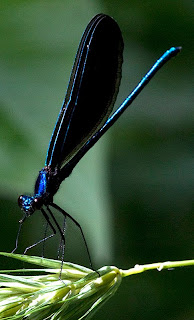
Dragonflies and damselflies (together comprising the order Ordonata) make up one of those classes of living things that I see all the time but have paid little attention to, at least beyond noting them flying about and the different colors of their wings. So because they are quite abundant around here this month, I decided to take a closer look. A single trip around the bottom field path figuratively netted three very different species, two dragonflies and one damselfly. It was easy to identify the guy to the left here as a damselfly, because he is holding his wings folded high when stationary, while dragonflies sit with their wings stretched out. Damselflies tend also to be distinguishable from dragonflies by their lacy, fluttering style of flight. This is a quite colorful example (probably because he's in the sun) of an ebony jewelwing (
Calopteryx maculata).
I'm no dragonfly biologist, let alone a card carrying member of the International Odonatological Society, so please correct me, but using James R. Curry's beautiful and informative book
Dragonflies of Indiana,

I have tentatively identified the dragonfly below as a female blue dasher (
Pachydiplax longipennis). Note the stretched and slightly downfolded wings, the white face, eyes close together and double row of yellow markings on the abdomen.
Dragonflies are amazing. Their larval stage is spent under water for a year or more, after which they emerge and go through a metamorphosis for a brief but frenzied few days or weeks as a flying adult, focused exclusively on eating and mating. And dragonflies are big eaters, they can consume their weight in flies and mosquitoes in an hour. Their compound eyes are composed of as many as 30,000 individual lenses each, and it is a testament to the wonder of life that their small, literally pin-head size brain can both coordinate their beautiful and intentional movements as well as interpret the rapidly changing visual scene in order to hunt prey and find a mate. Although some dragonflies get along almost anywhere near water, many species are adapted to very specific environments. This is another reason to conserve, recreate, or manage the specific habitats we find ourselves living in.
Finally, as an aside, I was reminded by the blue dasher image of why I like to take photographs. Click on her image immediately above to open a full resolution image in a separate browser window. OK, sure, taking pictures is something I can actually do. But it ends up as both a motivation and a path to examining the natural world. Examining almost any photograph (yes, sometimes even family snapshots) can reveal startling, unexpected, and beautiful details that aren't available in "real time," and force you to consider the differences, the commonalities, the "something new" present in those details. As stated above, I had never thought much about dragonflies, never having had the opportunity to look at them in the way we can look at butterflies or even birds, let alone a tree or blade of grass. But these images do something extra for me beyond the also enjoyable walk in the woods, and I hope they do for you as well.


 Dragonflies and damselflies (together comprising the order Ordonata) make up one of those classes of living things that I see all the time but have paid little attention to, at least beyond noting them flying about and the different colors of their wings. So because they are quite abundant around here this month, I decided to take a closer look. A single trip around the bottom field path figuratively netted three very different species, two dragonflies and one damselfly. It was easy to identify the guy to the left here as a damselfly, because he is holding his wings folded high when stationary, while dragonflies sit with their wings stretched out. Damselflies tend also to be distinguishable from dragonflies by their lacy, fluttering style of flight. This is a quite colorful example (probably because he's in the sun) of an ebony jewelwing (Calopteryx maculata).


 These ladybugs are captured. They are in the new handy little vacuum cleaner we recently purchased. We had to do something. The house at Habitat Home was literally crawling with Asian ladybugs (Harmonia axyridis). On warm autumn days during harvest the beetles start to swarm and fly about and eventually get into the house though any crack or crevice. Once inside they will settle down and overwinter if you let them. But I cannot. There are just too many of them. They are colorful and they do eat aphids but I just wish they would not come into the house in such great numbers.
 This male Carolina mantid (a version of praying mantis), almost three inches long, was found this afternoon on the tomato plants. Perhaps he was waiting for the small wasps to emerge from their cocoons on the dead tomato hornworms nearby. He turned his head over a wide range left and right to keep an eye on me while I was watching him. Although probably common in Illinois, we do not remember seeing these particular mantids before. We will keep an eye out for a mate and/or egg case, since it's that time of year.
 The potted tomato plants are still growing and producing lots of tomatoes. Is it any wonder then that there are tomato hornworms about? The horn is on the rear end of the worm. These are caterpillars of hawk moths, and so may possibly be the progeny of the hummingbird moth or a close relative. There are several hornworms crawling around on the tomato plants. Soon most of the leaves will be eaten if the worms are not removed. Handpicking is the easiest way to remove them, they are slow moving and fairly easy to spot on the undersides of the leaves. No insecticides or chemicals are needed. But for this one, I do not even have to do that. The white cylindrical attachments are cocoons of a predatory wasp. When the cocoons hatch the caterpillar will die and the wasps will go on to lay eggs on other tomato hornworms and repeat the cycle. A very interesting situation to observe.
 We are finally starting to see some grown praying mantis (Mantis religiosa). This one was out the other day patiently waiting for a tasty bug to come along. They will sit still for a long time and then at just the right moment, with amazing quickness, reach out that long spiny foreleg and grab an insect flying by. That is why the mantis is a symbol of patience and stillness in some cultures. Wonder what it means that the female will often eat the head of her male partner after mating.

 There are several hummingbirds that regularly visit the flowering plants and our feeder. Then there is this guy, Hemaris diffinis, which as far as we can tell (not being lepidopterists), goes by a number of common names including snowberry clearwing, or more generically, hummingbird moth, bumblebee moth, hawk moth, sphinx moth (family Sphingidae), etc. Although somewhat smaller, they do resemble the hummingbirds by their movements, their ability to hover and that they are always beating their wings, even when feeding. Their long proboscis can be easily seen in these two images, extended into the flowers of the butterfly-bush (Buddleja davidii).
 The butterfly weeds are blooming and they are covered with Bumble Bees. A friend brought me a poster that enables one to identify Bumble Bees. This poster is entitled Bumble Bees of Illinois and Missouri pub. by the Univ. of Illinois Dept. of Entomology. Look for females in late April through August. Don't look for males until August and September. (So this must be a female.) Then one has to look for a yellow thorax or a yellow thorax with a black spot. Then on down the chart one goes, noticing such things as black or yellow hair on top of head, the color of the segments, side view of head, eyes and so much more. Eventually one gets to identify the Bumble Bee. BUT, there is a little box off to the side, with red lettering! It says watch out for this one, the Carpenter Bee, Xylocopa virginica for it is often confused with the Bumble Bee. So is it Bombus impatiens the bumble Bee or Xylocopa virginica the Carpenter Bee?
 by Catherine Zimmerman
 by Douglas W. Tallamy
 by Andy Wasowski and Sally Wasowski
 by William Cullina
  by Michael R. Jeffords, Susan L. Post and Kenneth R. Robertson
 by William Cullina
 by Keith Gerard Nowakowski
 by Guy Sternberg with Jim Wilson
 by William Cullina
 by Sara Stein
 ed. by Cornelia F. Mutel and Stephen Packard; Society for Ecological Restoration
 by Willard Clay and Robert Hutchinson
