Showing posts with label Other. Show all posts

Friday, February 10, 2012

A Sign

Habitat Home now has an offical sign.
Thanks to our wonderful hunter, friend and artist, Cory. 
He is a man of many talents.


Cory made this sign and also these lovely flowers now blooming at Habitat Home.


Thank you Cory for making Habitat Home a home for some art too.
NOTE..the log in the first photo was artfully carved by one of the beavers at Habitat Home.

Saturday, March 26, 2011

Day after 16th Annual Prairie Burn

The view from our deck this morning.

Yes, we do burn every year because the area is a floodplain and produces so much vegetation. Please note the intentionally unburned areas on the right and very back of the prairie, leaving some bird and insect habitat intact.

Annual Prairie Burn

Prescribed burn (photo by Rachel Smith)This was the 16th burn of the tall grasses (Big Bluestem, Indian grass, Switch grass, and various forb stems) in the bottom floodplain at Habitat Home. We were a little reluctant to do the burn yesterday (Friday, March 25th) as there was not much wind (wind speed 5 mph with gusts to 8 mph) and it was cold (39 degrees). However, neighbors Tom, Sue, Rachel, Jake and friend Phillip, neighbors Betsy and Peter, and Master Naturalist Eileen were all able to help out despite the short notice. (It is spring break after all!)

We gathered together at 1 pm. Lex was the burn boss and explained the plan to the group. Everyone was outfitted in cotton clothes, boots, gloves, flappers and handkerchiefs. Water, both for drinking and fire suppression, was readily available. The local volunteer fire department was notified as were the neighbors. The burn was started against the wind, along the west edge and south borders, then moving to the upwind side along the east and north edges. It was one of the most classic burns, actually putting itself out when the various lines met. We were treated to high leaping flames and the heat from the fire was welcomed on such a cool day. The 5 acres were burned in less than 90 minutes. Thank you neighbors for all your flapping, and thank you Rachel for the photojournalism and permission to use this photo.

Saturday, March 12, 2011

Trash removal

Or is it Art?

We usually try to remove objects when they first float in, but for some reason this tire has remained in its artful position till today.

Today the weather was great for a spring cleanup. This time of year it is easy to spot trash that has been previously hidden by leaves, plants and snow.

This year there were a lot of plastic bottles, the usual aluminum cans, Styrofoam items and another tire. Unfortunately we were not prepared to haul out the old refrigerator that floated in. Wonder how we are going to get rid of that? It truly is not a piece of art.

Thursday, February 3, 2011

Ice

We are spending the day digging out from the previous snow and sleet storm here at Habitat Home. Everything is covered in ice. A beautiful sight this morning as tree branches and the snow sparkle in the bright sunlight. In this photo you will notice the ice but what you might not notice is the lack of crab apples on this crab apple tree. They are all gone. Usually the crab apples on this tree last though the winter (they must not be too tasty). But this year, the apples were all gone by Feb. 1. So remember to feed the birds. There is not much out there for them to eat and what is out there is covered in ice.

Sunday, August 22, 2010

Colorado Mushrooms

Who knew that there would be so many mushrooms along the hiking trails in Rocky Mountian National Park near the YMCA of the Rockies where we stay. I need help identifying them. These are just some of the photos.


Black-and-yellow Argiope

Black-and-yellow Argiope
Having just returned to Habitat Home from a long vacation in the Colorado Rockies, we found this spider waiting (for us?). It has established its web in amongst the flowers along the front entryway sidewalk where it is sunny but not too windy. We stood and watched for awhile as many innocent flying butterflies and insects fluttered by barely missing being trapped and eaten. These spiders will eat just about anything smaller than themselves. Spiders taste with organs on their feet. The end segment of the leg has several holes containing taste and smell organs. This spider is common in most of the United States but it is not common in the Rocky Mountains of Colorado.

Tuesday, June 15, 2010

Flooding

There have been times when we have been flooded in here at Habitat Home. Will this be such a time? The culvert under the driveway drains the savanna area and is sometimes not adequate to drain heavy rains, so the water washes over the driveway. Although still able to drive through this, the creek further down the road has a similar problem and floods the road. This we can not get through. It is not a wise idea to go though deep moving water on the country roads.
We are also watching as the river rises and floods the back tall grass prairie. The whole area may be covered with flood waters from the Salt Fork River by tomorrow morning.

Saturday, May 29, 2010

Sedges

I have been noticing more sedges (genus Carex) here at Habitat Home now that I am reading about them in a recently acquired book Field Guide to Wisconsin Sedgesby Andrew Hipp. Sedges have edges, grasses are hollow and rushes are round. This saying refers to the shape of the stem (culm) of the plant and is about as much as I know about sedges. Of course, as with all such sayings, there are exceptions. Sedges are an important part of all natural habitats so introducing sedges to any recreated habitat contributes greatly to the biodiversity of an area, but in order to do so one must be able to identify sedges. Many native nurseries are now offering sedges and even some regular nurseries are offering sedges for home gardeners because of the ornamental value sedges provide to a home garden. The Morton Arboretum is offering a workshop on sedges (June 17-18, 2010), which will be led by the Andrew Hipp, the author of the book mentioned above. I will be attending and if you are interested in recreating natural areas, I encourage you to learn more about sedges and attend the workshop.

If you get an error on the "workshop on sedges" link above, go to the Morton Arboretum site, click on "Adult Programs" in the Education tab, and then click on "Current Schedule of Courses..." link. This will give you a cookie that will allow you to successfully click on the workshop on sedges link. Bad peopleware.net!

Wednesday, May 26, 2010

Chain saw, weed whacker, fence cutter and herbicide sprayer.

This morning was spent using the chain saw to cut down the huge honeysuckle bushes along one of the old fence rows. The stumps were then sprayed with a 50% solution of Roundup. After the honeysuckle was removed we were able to remove some more of the old, old, fence that years ago confined the pigs that lived here. We then noticed some invasive yellow clover blooming in one of the old fields. So out came the weed whacker. The morning was spent dealing entirely with invasive species and old fencing. This can at times be overwhelming but one must remember that every invasive removed is helpful and that the job will never be finished. So, do not fret and worry, just do what you can to remove the invasives and old fencing from your property. These tools will all be out on many more mornings.

Friday, May 21, 2010

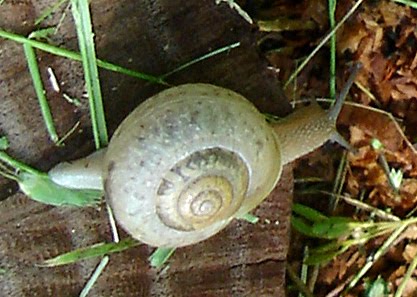
Land Snail

snail
We will be seeing more of these with all the rainy weather we are having. I rather enjoyed watching the little critter with it's beautiful shell inch along the stump it was walking on. Land snails can be a huge pest to both vegetable growers and gardeners as they are especially fond of lettuce and hostas. They deposit their eggs in the soil and within two weeks the eggs hatch into fully developed little snails, fully mobile and ready to eat. They themselves though are an important food source for many others, including birds, snakes, turtles, beetles and even humans. Don't think I will eat him/her however, I am glad to see land snails here at Habitat Home.

Thursday, April 22, 2010

Managed Earth

Today is Earth Day. The map below illustrates what the earth at Habitat Home is looking like. I have found it very helpful to name the areas that we are recreating here. This is not restoration work as there was nothing to restore here but corn and beans. This land had either been farmed, mowed or grazed for many years prior to our ownership. We decided to manage for types of areas that had existed in east central Illinois prior to settlement. We are recreating a tall grass prairie, a savanna, the riparian woodlands, an orchard, and a meadow. We have also created the landscape around the house.

Most of the land in Illinois has been disturbed and that is why we must manage. In well established prairies and woodlands and meadows, invasives are not able to get a foothold. But when the area is small and not established many plants can grow there and they will. I have added a new sidebar link to the Midwest Invasive Plant Network. Please check it out. The site does a much better job than I do of explaining why we should be concerned about invasive species and gives lots of information about how to manage your property.

This earth day is a good time to consider what type of earth you want, and then manage your property accordingly. Large or small acreage or yards can be used to grow native plants that in turn attract native insects, birds and mammals. And that is what makes us uniquely east central Illinois...and, of course, the corn and beans.

Tuesday, March 23, 2010

Prairie Burn


Today marked the (mostly-)annual burn of the 5+ acre Habitat Home prairie. There wasn't much wind, so the burn was not as "exciting" as it sometimes is, but the grasses were quite thick following the good season last year, so everything burned quite well.

Although it looks like it could be dangerous, and you always have to respect fire, we are always very careful and methodical about our burns. We always start burning from the downwind side, creating slow-burning firebreak extensions to the existing natural breaks around the perimeter of the field, and have a crew armed with flappers and a roving water tank. The video above (about two and a half minutes) shows a couple of scenes from the more upwind side where the wind, such as it was, pushed the fire a bit more aggressively. Note the smoke in the background where the firebreak fire is burning slowly upwind.

Grass fires were a common, natural occurrence in the North American Prairie. Burning is very beneficial to native grasses: it can promote seed germination, it kills competing species (e.g., trees, shrubs, and non-native, invasive plants), it releases nutrients into the soil, and opens the ground up for light and warming that encourages new growth. Following a burn, we often see more owls and hawks around the perimeter of the field, where they have an easier time spotting mice, voles, and snakes moving around.

The prairie field is an important part of Habitat Home. The tall grasses - mostly Switch Grass (Panicum virgatum), Big Bluestem (Andropogon gerardii), and Indian Grass (Sorghastrum nutans) - and forbs provide seed, nectar, and cover for a variety of insects, butterflies, birds, and small mammals. There are so few acres of prairie left in Illinois that every little bit helps!

All in all, a successful burn!

p.s. I apologize for the black frame, rather than the first content frame, in the initial view in the video window above. This has been happening for the past six weeks or so. It appears that google is trying to discourage blogger-resident videos and get us to use youtube. They don't force it, they don't say it, they just make it increasingly inconvenient to upload and use videos in blogger. Bother!

Saturday, March 6, 2010

Spring Clean Up

One of the first things I try to get done come spring is trash removal.  Living along the river means that when the river floods it brings lots of trash with the flood waters.  Then as the water recedes, the trash is deposited here.  So on this nice sunny day I walked the river trail and the prairie trail picking up everything from bottles to shoes. There is still a tire with rim out there that will require the lawn tractor for removal.  The most prevalent of all, however, is styrofoam - foam cups, foam plates and foam containers.  So I am getting on my soap box here and asking readers to think about styrofoam and what an impact it has on the environment.  I encourage you to consider alternatives to styrofoam NOW, today, on this beautiful sunny day.

Tuesday, February 9, 2010

Winter Brushpiles

We were out snowshoeing today,
and noticed trails into all the brushpiles.
We have set up several brush piles on the property. These piles are mostly honeysuckle bushes that we had cut down last summer. We haul and pile up the branches in good spots, the best being locations at the edge between two adjoining habitats. The photo above shows a pile at the edge between the woodlands and the prairie, and quite a path coming from and going into the pile. I could not discern individual tracks, so I am free to speculate what is making these paths. Various animals use brush piles for both home and shelter from predators. Chipmunks, rabbits, voles, groundhogs and even Bobwhite quail (if you are lucky ebough to have Bobwhite quail!) use brushpiles. I checked several sources and not one mentioned squirrels using brushpiles, but we have so many squirrels here that they are probably the ones making or at least contributing to these paths.

Saturday, February 6, 2010

Snowing

Last night it snowed yet again. Everything was covered in snow this morning and it was beautiful! So many people say that they are getting so tired of the snow, but I cannot really say that,  for each snowfall has been so different.  Each snowfall has created it's own unique scenes at Habitat Home.

Tuesday, January 5, 2010

Skating Pond

The bitter cold weather continues. We hiked down to the river today to see if it was frozen over. It was not. However, we did find this small frozen pond. This is a low area along the river that fills with water whenever the river floods and then remains a small pond for some time. The river flooded right before it turned cold. So, we have a small frozen pond that would be great for skating, except that there is no water underneath this ice and the ice itself is too thin to support much weight. No skating here.

Wednesday, December 30, 2009

Christmas tree Disposal

Did anyone notice I have taken a few months off from my Blog?

The holidays are a busy time for me. Thanksgiving and Christmas are busy with family and friends and cooking and cooking and cooking. It is all good, though, as it comes at a time when things at Habitat Home have slowed down.

But now with seed catalogs coming in the mail and the next month gardening magazines arriving, I am anxious to resume documenting things about Habitat Home. So from now until spring, when things start growing again, I will be writing just a weekly post about things at Habitat Home. Like Christmas tree disposal. Each year we buy a fresh tree. We used to go cut one down at a local tree farm but as we have gotten older we now just go into town and buy one. The trees are usually on sale by the time we buy one so close to Christmas.

The tree was up in the house only a bit more than a week but was already getting rather dry and brittle. Today it was removed from the house and we had the ceremonial Christmas tree fling over the deck to the ground below. The tree will roll about the back yard for the rest of the winter. It serves as a great resting spot and protection from the weather for various birds and rabbits and squirrels and probably other critters I would rather not think about. When spring arrives and the need for such diminishes, the tree will be hauled to the burn pile, its final resting place.

Friday, November 20, 2009

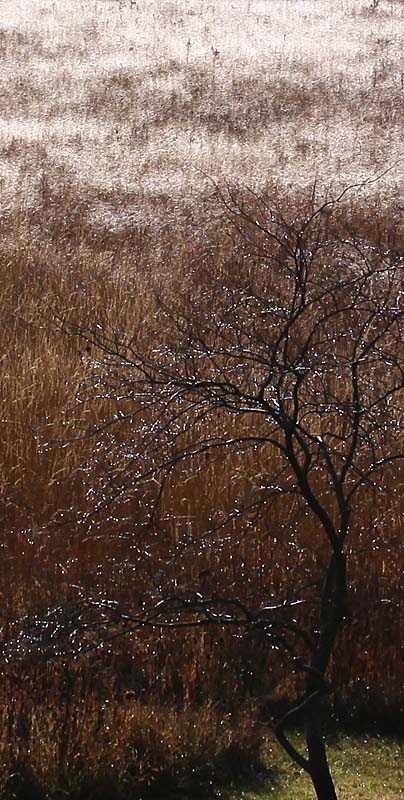
Dew

This was the scene this morning at Habitat Home. Everything was covered in dew. The trees glistened and the grasses were white. What a magical sight.

Today has turned out to be a beautiful day. We have had so much rain lately that the ground is very soft. So I spent the afternoon pulling up honeysuckle in the woodlands by the house. I am now able to determine in a single glance which little honeysuckle bushes I can uproot with nothing but my gloved hands!

Thursday, October 15, 2009

Climate Change and Wildlife Habitat

This post is part of an October 15, 2009 Blog Action Day exercise in which thousands of bloggers are writing about a single topic, climate change, within the context of their site’s focus area. Our message here is simple: Individuals need to consider their local environment as wildlife habitat and take action to protect and improve it, thereby reducing the stresses on plant and animal populations that will come with climate change.

We at Habitat Home find the prospect of the gradual warming of the global environment over the next century to be sufficiently likely to justify careful study and consideration. But the hysteria or “crisis” promoted by the global warming “movement” is disturbing. The focus needs to shift from one of promulgating fear and guilt over climate change, or demanding ever more control (with cost a relatively unimportant criterion) to reduce or stop it, to a focus of how we can manage or even adapt to that change as it occurs. Yes, we need to consider and invest in alternate energy sources, and yes, we may need to adjust our lifestyles. But these things are likely to happen anyway as the fossil fuels are depleted, the economics of energy shift, the global economy becomes more real, and the growth of the human population stabilizes. There will be “change we can believe in.” But unlike the euphoria of the 2008 U.S. presidential election and its instant gratification, changes in global environments and the behavior of populations, societies and economies are not going to change overnight, and certainly not by some local or even multi-national sets of legislation or treaties. No matter how good we may feel about ourselves for short term “accomplishments” in the form of promises or even actual reduction in greenhouse gas emissions, atmospheric carbon dioxide will continue to increase and climate changes will continue to loom on the long term calendar. Perhaps we can delay the effects by a few years over the next century, but such a delay may not be very significant.

Instead, or at least in tandem to the hysteria, what is needed is some long range thinking, research, and action to prepare our environments in all aspects (natural, societal, economic) for the likely climate changes that are going to occur. While we may not be able to reduce those changes very much, we can significantly reduce the stresses that those changes bring.

Habitat Home is all about the natural environment and a very local ecosystem of twenty acres. But those twenty acres are part of a larger collection of plant and animal habitat pockets, corridors and reserves scattered within the U.S. Midwest and the state of Illinois. With the expansion of the United States in the 18th and 19th centuries, the spread of the population westward, the acquisition and distribution of land ownership, and the development of industry, agriculture and urban areas, the natural areas of Illinois have already experienced tremendous and (certainly to plants and animals) very stressful change over the past 200 years. Over the next 100 years, climate change may well replace direct human activity as the greatest threat to plant and animal species and their habitats. In fact, effects of climate change are already being observed. The U.S. Global Change Research Program (USGCRP) issued an extensive report in June, 2009 – “Global Climate Change Impacts in the United States” – which summarizes results of current research and predicted impacts for the U.S. Of particular interest to this blog are the sections on the U.S. Midwest region and on Ecosystems. The report notes examples of regional and ecosystem changes that have already been occurring over the past few decades, such as “large-scale shifts have occurred in the ranges of species and the timing of the seasons and animal migration, and are very likely to continue.”

It behooves us, both collectively and individually, to do what we can to anticipate and reduce the stresses brought by these changes in ecosystems by conserving, protecting, and nurturing the natural features of any areas that we control or affect.

What can we do? Any more, we seem to first look to the government. But the list of common or “public” issues for which control is given to (or taken by?) various levels of government is growing, seemingly exponentially. Even before the recent economic downturn governments have reduced their commitments to the acquisition, development and maintenance of natural areas. Indeed, the looming dreams and resulting costs of the growing entitlement state will likely swamp any ability to support natural areas at the levels we became accustomed to in the 20th century. State and local parks and preserves are less able to maintain the areas they already have as funding is cut and managers are given other priorities. Another type of government action, and one that all governments love, is to enact legislation and regulation, especially when there are no direct costs or where costs can be passed along to someone else. Such efforts are often counterproductive and are rife with unintended consequences. We saw this first-hand four years ago when Champaign County tried to institute new zoning regulations aimed specifically at reducing rural residential development, and purportedly protecting natural resources. As we pointed out in public hearings, these regulations would have exactly the opposite effect as that intended with respect to conserving natural areas. Not only did the proposals specifically exempt agricultural uses from any of the so-called conservation measures, they reduced the ability of individual landowners to implement well-intentioned management practices they might undertake. Two multi-year efforts to enact such regulations fortunately were defeated by the County Board.

So where can we turn for help? The most effective answer is for us - residential and corporate landowners, farmers, etc. - to educate ourselves about the natural characteristics of our properties, and how those characteristics provide habitat for plants, insects and animals. Look around and notice the plants, insects, birds, mammals and fish with which you are sharing the land and water. Pick up and read some of the books listed in the right sidebar, or any of numerous other publications on the nature and preservation of habitats. You can easily learn to intentionally design and implement conservation, restoration and protection practices that will enhance habitats. The added cost is often zero! Plant native species, landscape with an eye toward beneficial shrubs, trees and plant communities, avoid chemicals or use them only sparingly for specific targets, consider the effects of your pets. Not only will such activity benefit your property immediately, it will increase the amount and quality of habitats thereby reducing the stresses on plant and animal populations that will inevitably occur as climates gradually change through the century.

Join Habitat Home in celebrating the natural world we experience all around us, and in finding joy in working toward being good stewards and doing the right thing!